


Quick Answer
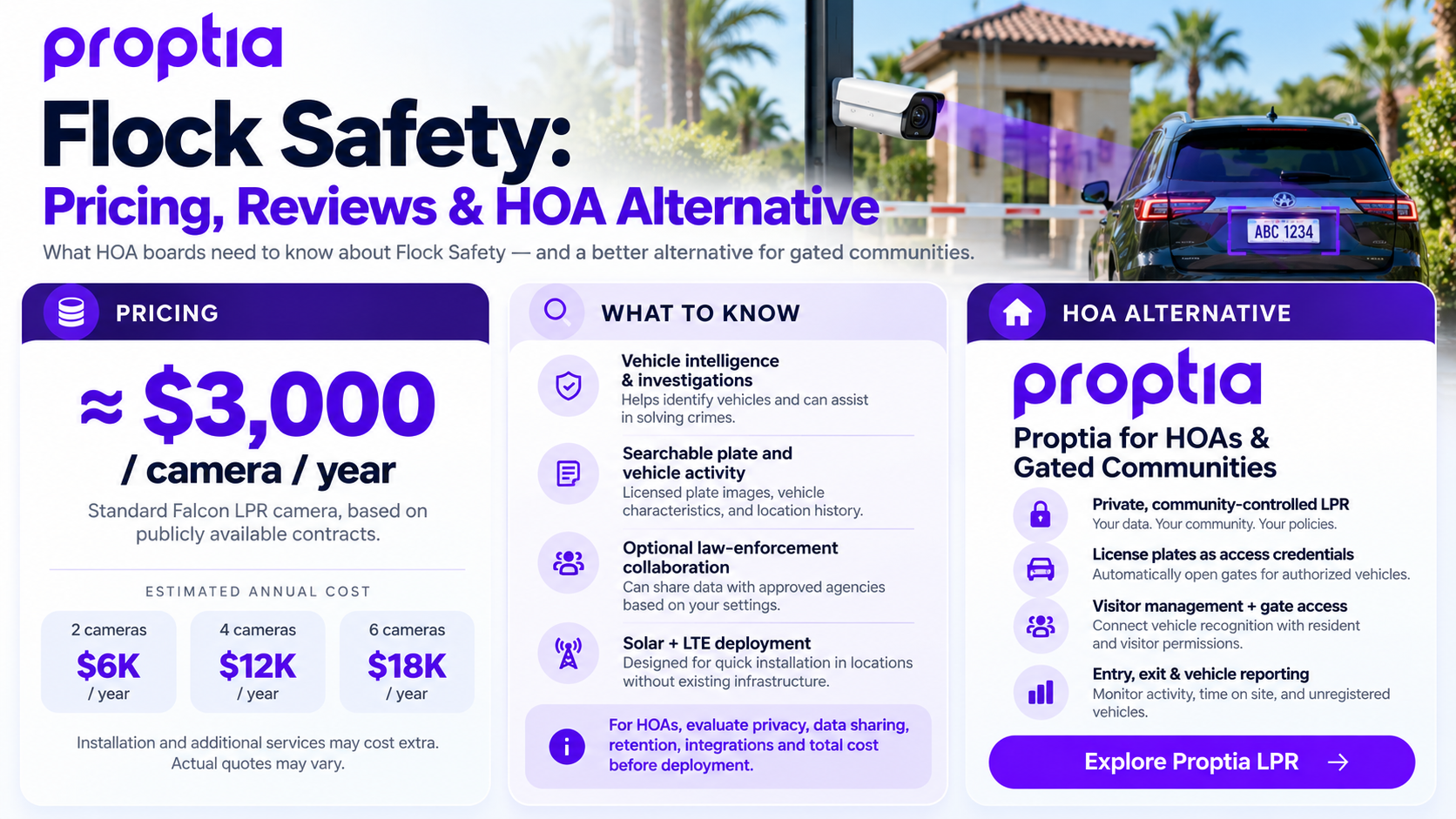
Flock Safety is a license plate recognition (LPR) and vehicle intelligence platform used by law enforcement, businesses, and residential communities. Flock Safety’s standard Falcon LPR cameras cost approximately $3,000 per camera per year, based on publicly available government contracts. For HOAs, the most important considerations are total cost, data ownership, retention, privacy, law enforcement sharing, and integration with existing security systems. Gated communities should also evaluate alternatives such as Proptia, which integrates LPR with resident access, visitor management, gate controls, and community security operations.
What Is Flock Safety?
Flock Safety is an Atlanta-based public safety technology company founded in 2017.
The company provides automated license plate recognition (ALPR) cameras, video surveillance technology, vehicle intelligence software, and other public safety solutions.
Its customers include law enforcement agencies, businesses, homeowners associations (HOAs), residential neighborhoods, and commercial properties.
Flock is particularly known for its connected vehicle intelligence platform, which allows authorized users to search recorded vehicle activity and, where enabled, share information across participating organizations.
Its cameras capture license plates and vehicle characteristics, including make, model, color, and distinctive features.
For HOAs, Flock can help document vehicle activity, identify vehicles associated with security incidents, and provide information that may assist law enforcement investigations.
However, license plate recognition has evolved considerably since Flock entered the market.
Today, HOA boards are asking questions that extend beyond camera performance:
- How much does Flock Safety cost?
- Who owns the license plate data?
- Can law enforcement access community vehicle records?
- How long is information retained?
- Can the HOA restrict external sharing?
- Does the system integrate with existing gates?
- Can license plates function as resident access credentials?
- What alternatives are available for private gated communities?
These questions reflect a broader shift in how communities evaluate vehicle security technology.
The important question is no longer simply whether a camera can recognize a license plate. It’s what happens after the plate is recognized.
Flock Safety Pricing for Residential Communities
Flock Safety’s standard fixed Falcon LPR camera costs approximately $3,000 per camera per year, based on publicly available government procurement contracts.
A Michigan state procurement agreement lists the fixed Falcon camera at $3,000 annually, including hardware, software, maintenance, cellular LTE connectivity, and cloud storage.
This provides a useful public pricing benchmark, although actual HOA pricing may vary depending on equipment, contract terms, deployment requirements, and negotiated pricing.
Flock operates primarily through a subscription model rather than a traditional one-time camera purchase.
Flock Safety Annual and Five-Year Cost Estimates
| Number of Cameras | Annual Subscription | Five-Year Subscription Cost |
|---|---|---|
| 2 cameras | $6,000 | $30,000 |
| 4 cameras | $12,000 | $60,000 |
| 6 cameras | $18,000 | $90,000 |
| 8 cameras | $24,000 | $120,000 |
| 10 cameras | $30,000 | $150,000 |
Estimates assume $3,000 per camera annually and exclude installation, additional services, future price increases, and negotiated discounts.
For a gated community with multiple entrances and exits, camera requirements can increase quickly.
A community with three entrances and three exits may require six or more cameras, depending on lane configuration and desired coverage.
At the $3,000 annual benchmark, six cameras would represent approximately $18,000 per year or $90,000 over five years before additional expenses.
How Much Does Flock Safety Installation Cost?
Installation costs depend on the equipment and deployment.
Flock’s published professional services schedule lists initial camera installation charges of approximately:
| Installation Type | Published Fee |
|---|---|
| Existing infrastructure | $1,000 |
| Standard installation | $1,000 |
| Advanced installation | $1,250 |
These published charges are reference points, not guaranteed pricing for every HOA deployment.
Additional costs may apply for specialized infrastructure, camera relocation, equipment protection, or site-specific requirements.
What Is the Total Cost of Flock Safety for an HOA?
HOA boards should evaluate the total cost of ownership rather than focusing exclusively on the annual camera subscription.
That includes:
- Camera subscriptions
- Installation and infrastructure
- Additional software or services
- Contract length and renewal terms
- Maintenance and equipment replacement
- Data retention requirements
- Third-party integrations
- Gate access control
- Visitor management
- Guardhouse operations
For gated communities, the relevant comparison is not simply the cost of an LPR camera.
It’s the total cost of meeting the community’s vehicle security and access control requirements.
How Does Flock Safety Work?
Flock Safety uses specialized cameras and cloud-based software to identify vehicles and create searchable records.
When a vehicle passes a Flock camera, the system captures an image of its license plate and identifying vehicle characteristics.
The software processes that information and associates it with a timestamp and camera location.
Authorized users can then search vehicle activity using information such as license plate numbers, vehicle characteristics, locations, and time periods.
Depending on the deployment, Flock can also generate alerts when a detected vehicle matches an authorized hotlist.
What Is Flock Safety’s Vehicle Fingerprint Technology?
Flock’s Vehicle Fingerprint technology helps identify vehicles using characteristics beyond the license plate.
These can include vehicle make, model, color, body type, and other distinguishing features.
This capability is useful when a license plate is obscured, unavailable, or unknown.
For example, security personnel investigating a vehicle involved in property damage may know only that it was a white pickup truck.
Vehicle characteristic searches can help narrow the relevant records.
Does Flock Safety Require Internet Connectivity?
Many Flock Falcon cameras use cellular LTE connectivity and can operate with solar power.
This makes them useful in locations where running electrical or network infrastructure would be difficult.
Vehicle information is transmitted to Flock’s cloud platform for processing, storage, and authorized searches.
Communities should evaluate cellular coverage, camera placement, connectivity requirements, and how the system handles temporary outages before installation.
How Does Flock Safety’s Connected LPR Network Work?
One of Flock Safety’s distinguishing capabilities is its connected vehicle intelligence network.
Traditional standalone license plate recognition systems generally capture vehicle activity within a defined property or deployment.
Flock’s platform can support broader collaboration by allowing authorized organizations to share vehicle information across participating systems.
For law enforcement, this can be valuable when investigating vehicles that travel across multiple jurisdictions.
For residential communities, the same architecture introduces additional considerations involving privacy, permissions, and external access.
Does Flock Automatically Share HOA License Plate Data?
No. Flock states that customers own their data and control whether it is shared.
According to Flock’s published policies, external sharing is disabled by default and must be authorized by the customer.
Flock also states that it does not sell customer data.
This distinction is important.
A connected LPR platform is not necessarily a system where every participating organization can access every camera.
However, because Flock supports broader information sharing, HOA boards should understand exactly how those capabilities are configured.
Communities should determine who can authorize sharing, whether permissions can be restricted, and how searches and disclosures are audited.
How Does Flock Safety Work With Local Law Enforcement Agencies?
Flock Safety supports law enforcement investigations through searchable vehicle records, authorized hotlists, and information-sharing capabilities.
Participating agencies can use vehicle intelligence to investigate stolen vehicles, missing persons, property crimes, and other legitimate public safety matters.
Depending on system configuration, authorized hotlists can generate alerts when a matching vehicle is detected.
Flock also allows participating organizations to collaborate by sharing approved information.
For HOAs, the important consideration is how community-owned vehicle records may become available to outside organizations.
Flock states that customers determine whether to share their information with law enforcement.
However, HOA boards should establish written policies addressing:
- Who can authorize law enforcement access
- Whether ongoing sharing is permitted
- Whether requests are reviewed individually
- How access permissions are documented
- Whether sharing can be disabled
- How searches and disclosures are audited
- How legal requests for vehicle information are handled
These decisions should be made before cameras are installed.
Potential Benefits of Flock Safety
1. Vehicle Intelligence for Security Investigations
License plate recognition can provide useful information following a security incident.
Instead of manually reviewing hours of conventional video, authorized users can search recorded vehicle activity by plate number, vehicle characteristics, location, or time.
This can help narrow investigations involving theft, vandalism, property damage, or suspicious vehicle activity.
2. Alerts for Vehicles of Interest
Depending on the deployment, Flock can notify authorized personnel when a vehicle associated with an approved hotlist is detected.
These alerts can improve situational awareness and support appropriate security responses.
However, a license plate match should be treated as investigative information rather than proof that a driver or occupant has committed a crime.
3. Broad Vehicle Coverage
Flock’s solar-powered and LTE-connected cameras can simplify installation where conventional network infrastructure is unavailable.
This makes the technology useful for residential neighborhoods, commercial properties, and other locations seeking vehicle visibility across multiple areas.
4. Searchable Vehicle History
Flock allows authorized users to search historical vehicle activity.
This can help determine whether a particular vehicle appeared near a location during a specific time period.
Searchable records can be useful for security investigations and incident documentation.
5. Optional Law Enforcement Collaboration
Flock’s connected architecture supports authorized information sharing between participating organizations.
For communities prioritizing investigative collaboration, this can be a meaningful advantage.
However, broader connectivity should be evaluated alongside the community’s privacy policies and data governance requirements.
Connected LPR Networks vs. Private Community-Controlled LPR
Not every license plate recognition system is designed around the same operating model.
Some platforms emphasize vehicle intelligence across multiple locations and organizations.
Others emphasize identifying vehicles within a defined property and connecting that information to resident permissions, visitor authorizations, and gate operations.
For HOA boards, understanding this distinction can help clarify which type of system best supports their requirements.
| Consideration | Connected Vehicle Intelligence | Private Community-Controlled LPR |
|---|---|---|
| Primary purpose | Vehicle identification and investigations | Vehicle access and community security |
| Typical environment | Public safety, neighborhoods, businesses | Gated communities and private properties |
| Geographic scope | Can extend across participating locations | Primarily community-defined entrances and property |
| Data sharing | May support broader network collaboration | Governed around community-specific policies |
| Resident identification | May identify registered resident vehicles | Can connect vehicles with resident access records |
| Visitor management | Depends on available integrations | Can connect plates with visitor authorizations |
| Gate operation | Depends on system capabilities and integrations | Can use plates as access credentials |
| Reporting | Vehicle searches and investigative records | Vehicle activity, access transactions, and community reporting |
| Primary consideration | Investigative coverage and intelligence | Integrated access operations and data governance |
These are operating models, not absolute categories. Actual capabilities depend on the provider, configuration, integrations, customer agreements, and community policies.
Why This Matters for Gated Communities
Consider two situations.
In the first, an HOA wants to identify vehicles passing through its neighborhood and provide evidence when security incidents occur.
A vehicle intelligence platform such as Flock may be well suited to that objective.
In the second, a gated community wants to recognize a resident’s vehicle, verify that its access permissions remain active, open the appropriate gate, and record the transaction.
The community also wants to recognize expected visitors, identify unregistered vehicles, and connect entry and exit activity with security reporting.
That requires a more integrated access control workflow.
The difference is not simply whether the camera can read a license plate. It’s what the software can do with that information.
Who Owns and Controls Flock Safety License Plate Data?
Data ownership has become an important consideration for HOA boards evaluating license plate recognition.
Flock Safety states that customers retain ownership of their data and control authorized access and sharing.
Its updated 2026 policies emphasize customer ownership, configurable retention, access permissions, and auditability.
That is an important distinction because participation in a connected LPR ecosystem does not necessarily mean a customer has surrendered ownership of its records.
However, ownership is only one part of data governance.
An HOA should distinguish between four separate questions:
- Who contractually owns the information?
- Who controls how the information can be used?
- Who technically stores or processes the information?
- Who can search, export, retain, delete, or share it?
A contract stating that the HOA owns its data does not automatically answer all four.
Can Flock Safety Share HOA Data With Police?
Flock supports optional law enforcement sharing.
The company states that customers control whether information is shared and that sharing is disabled by default.
HOA boards should nevertheless verify the actual configuration of their deployment and establish written authorization procedures.
Does Flock Safety Sell License Plate Data?
Flock states that it does not sell customer data.
Its published policies also emphasize that customers retain ownership of the information collected through their systems.
Can an HOA Audit Who Searches Its Vehicle Records?
Flock provides audit capabilities intended to document searches and access activity.
Communities should confirm which audit logs are available to private customers, what information they contain, and how long those records are retained.
How Long Does Flock Safety Store License Plate Data?
Flock Safety’s current standard retention period for LPR data is seven days, according to its updated 2026 evidence and data retention policies.
Flock states that customers can configure retention according to applicable laws, contractual requirements, and community policies.
Its published evidence policy also describes options for extended retention and preserving information associated with active investigations.
This represents an important change from older descriptions of Flock’s standard 30-day retention period.
However, some existing contracts and product configurations may still specify different retention arrangements.
For HOA boards, the correct question is not simply how long Flock retains data by default.
It’s whether the community can establish and enforce a retention policy appropriate for its security needs.
Boards should ask:
- What is the default retention period for our deployment?
- Can the HOA modify that period?
- Are there additional costs for extended retention?
- Can specific records be preserved during an investigation?
- Are records automatically deleted when retention expires?
- Can the community verify deletion?
- What happens to exported or externally shared records?
Retention should be documented in the agreement and reflected in the community’s written LPR policy.
Why Flock Safety and LPR Privacy Are Receiving More Scrutiny in 2026
License plate recognition has become a prominent topic in discussions about surveillance, privacy, and public safety.
As interconnected camera networks expand, questions have emerged about who can search vehicle records, how information moves between organizations, and whether existing safeguards adequately prevent unauthorized access.
Flock Safety has faced scrutiny over these issues.
California Data-Sharing Concerns
In March 2026, Flock acknowledged that some California law enforcement camera networks had been inadvertently accessible to out-of-state law enforcement agencies during portions of 2025.
The company stated that earlier technical logging limitations made it difficult to determine the precise cause of some reported sharing incidents.
Flock subsequently announced additional safeguards intended to improve access controls and compliance.
This development illustrates why organizations should evaluate actual permissions, technical safeguards, and auditability rather than relying exclusively on broad assurances about data ownership.
It does not establish that every Flock customer experienced unauthorized sharing.
Increased Public and Government Scrutiny
In October 2026, Reuters reported growing public and governmental opposition to some deployments of Flock’s surveillance technology.
Several municipalities have reconsidered their use of connected license plate recognition systems, citing concerns about privacy, access controls, and data sharing.
Other communities and law enforcement agencies continue using the technology because they consider its investigative benefits valuable.
For HOA boards, the lesson is not that license plate recognition is inherently inappropriate.
It’s that privacy, transparency, and data governance should be evaluated alongside camera performance and security benefits.
Is Flock Safety Legal for HOAs?
License plate recognition laws vary by state, camera location, operator, and intended use.
A restriction affecting law enforcement cameras or installations on public roads does not automatically prohibit an HOA from operating LPR cameras on private property.
Likewise, private ownership does not exempt a community from every applicable privacy, security, or data-protection requirement.
California
California has specific laws governing automated license plate recognition systems.
Civil Code sections 1798.90.51 through 1798.90.55 establish requirements involving ALPR usage policies, security safeguards, access controls, and recordkeeping.
These provisions can affect private ALPR operators and end users.
California HOAs should review their obligations concerning written policies, authorized access, auditing, and data protection.
Florida
Florida has restrictions affecting certain law enforcement and transportation-related uses of license plate recognition.
However, the legal analysis can differ depending on whether cameras are installed on public roadways, state transportation infrastructure, or private community property.
HOAs should evaluate their specific deployment rather than assuming that restrictions on government-operated systems automatically apply to private gated communities.
Texas
Texas communities should evaluate applicable state and local requirements, particularly when LPR systems involve public infrastructure or law enforcement information sharing.
Private HOAs should also establish clear policies governing access, retention, and disclosures.
For a more detailed discussion, see Proptia’s guide to License Plate Recognition for HOAs: Privacy, Data Ownership, Laws, and Best Practices for 2026.
Potential Concerns With Flock Safety
1. Integration With Existing Gated-Community Systems
Flock Safety offers integrations and APIs, particularly within public safety and law enforcement technology environments.
However, the availability of an API does not automatically mean a platform supports every workflow required by a gated community.
An HOA may need its LPR system to communicate with:
- Resident and household databases
- Visitor management software
- Gate operators and access controllers
- Guardhouse processing systems
- Property management software
- Intercoms and visitor kiosks
- Vehicle access permissions
- Community security reporting
Boards should confirm whether each required integration is supported, how it operates, and whether additional equipment or software is necessary.
For communities that want license plates to function as resident and visitor credentials, the integration between LPR and access control deserves particular attention.
2. Cellular Connectivity and Infrastructure
Flock’s solar-powered and LTE-connected cameras can be advantageous where wired power and network connections are unavailable.
However, communities should still evaluate cellular coverage, camera placement, upload performance, and procedures for connectivity interruptions.
Ask how the system behaves during an outage, whether events are buffered, and when records become searchable again.
3. Data Retention and External Sharing Policies
Connected LPR platforms can support valuable investigative collaboration.
They also require clear policies governing who may access or share vehicle information.
An HOA should establish written procedures for retention, authorized searches, disclosures, and responding to outside requests.
These are governance considerations rather than evidence that a particular platform automatically shares data without permission.
4. Long-Term Subscription Costs
Flock’s subscription model can simplify hardware maintenance and software management.
However, recurring camera costs can become significant as a community adds entrances, exits, or additional surveillance locations.
At approximately $3,000 per camera annually, a ten-camera deployment represents roughly $30,000 in annual subscription costs before additional expenses.
Boards should evaluate renewal terms, equipment replacement obligations, and the cost of expanding coverage.
5. Contract Flexibility and Offboarding
Communities should understand their contractual obligations before selecting any LPR provider.
Important considerations include:
- Initial contract length
- Automatic renewal provisions
- Early termination requirements
- Equipment ownership
- Camera removal responsibilities
- Data export options
- Historical record deletion
- Transition support
These considerations become especially important when an HOA wants to change providers or revise its privacy policies.
Why Some Gated Communities Prefer Private LPR
For communities with controlled entrances, license plate recognition can serve a different purpose from neighborhood surveillance.
Rather than simply documenting that a vehicle passed a camera, the system can determine whether the vehicle is authorized to enter.
For example, a community may want to answer:
- Does this plate belong to a current resident?
- Is the vehicle associated with an expected visitor?
- Who authorized the visit?
- Is the visitor’s access permission still valid?
- Which entrance did the vehicle use?
- Has the vehicle exited?
- How long has the vehicle been on the property?
- Is there an active security alert associated with the plate?
These questions connect vehicle recognition with everyday community operations.
A private, community-controlled LPR approach centers the system around the HOA’s property, access policies, and security requirements.
That does not automatically make one system more secure than another. Security and privacy still depend on the underlying architecture, permissions, retention controls, vendor practices, and community policies.
The advantage is the ability to design the LPR workflow around the community’s specific operational needs.
Alternatives to Flock Safety
Flock Safety is not the only approach available to an HOA evaluating license plate recognition.
The right alternative depends largely on what the community wants LPR to accomplish.
A neighborhood primarily interested in identifying vehicles after security incidents may prioritize investigative search capabilities and broad vehicle coverage.
A gated community may place greater emphasis on connecting vehicle recognition with residents, visitors, gates, credentials, and security operations.
Proptia: LPR Integrated With Gated-Community Security Operations
For HOAs evaluating Flock Safety alternatives, Proptia offers a different approach to license plate recognition.
Rather than treating LPR primarily as an investigative camera system, Proptia connects vehicle recognition with the broader access and security operations of gated communities.
Proptia’s platform combines license plate recognition, visitor management, access control, resident credentials, guardhouse operations, intercoms, amenity access, and reporting.
The system is purpose-built for HOAs, gated communities, private residential developments, and similar controlled-access environments.
License Plates as Access Credentials
Proptia allows communities to associate authorized license plates with resident or visitor access permissions.
When a registered vehicle approaches an entrance, the system can recognize the plate, verify authorization, and trigger the gate.
For visitors, residents can register guests and associate a license plate with the appropriate visitor permissions.
When the visitor arrives, the recognized plate can be connected to that active authorization rather than existing only as an unidentified vehicle record.
This can reduce manual processing while preserving a record of the access transaction.
Entry and Exit Vehicle Reporting
When LPR cameras are deployed at community entrances and exits, Proptia can connect vehicle activity with access transactions.
Depending on configuration, communities can review:
- Vehicle entry and exit history
- Vehicles currently on property
- Time spent inside the community
- Unregistered vehicle activity
- Overstay activity
- Cut-through vehicle activity
- Roving vehicle activity
- Vehicle make, model, color, and type
- Security alerts and relevant vehicle activity
These records can help property managers and security teams understand what is happening inside the community rather than simply which plates passed a camera.
Connected Visitor Management and Access Control
Proptia integrates LPR with the same platform communities use to manage resident access, visitor permissions, credentials, and security operations.
That means a license plate can be connected to an authorized household or visitor rather than existing only as an isolated vehicle record.
Communities can also combine LPR with other access technologies, including Bluetooth mobile credentials, RFID, QR codes, PINs, key fobs, and other credentials.
This flexibility allows communities to support different entrances, resident preferences, and operational requirements without requiring every vehicle to use the same access method.
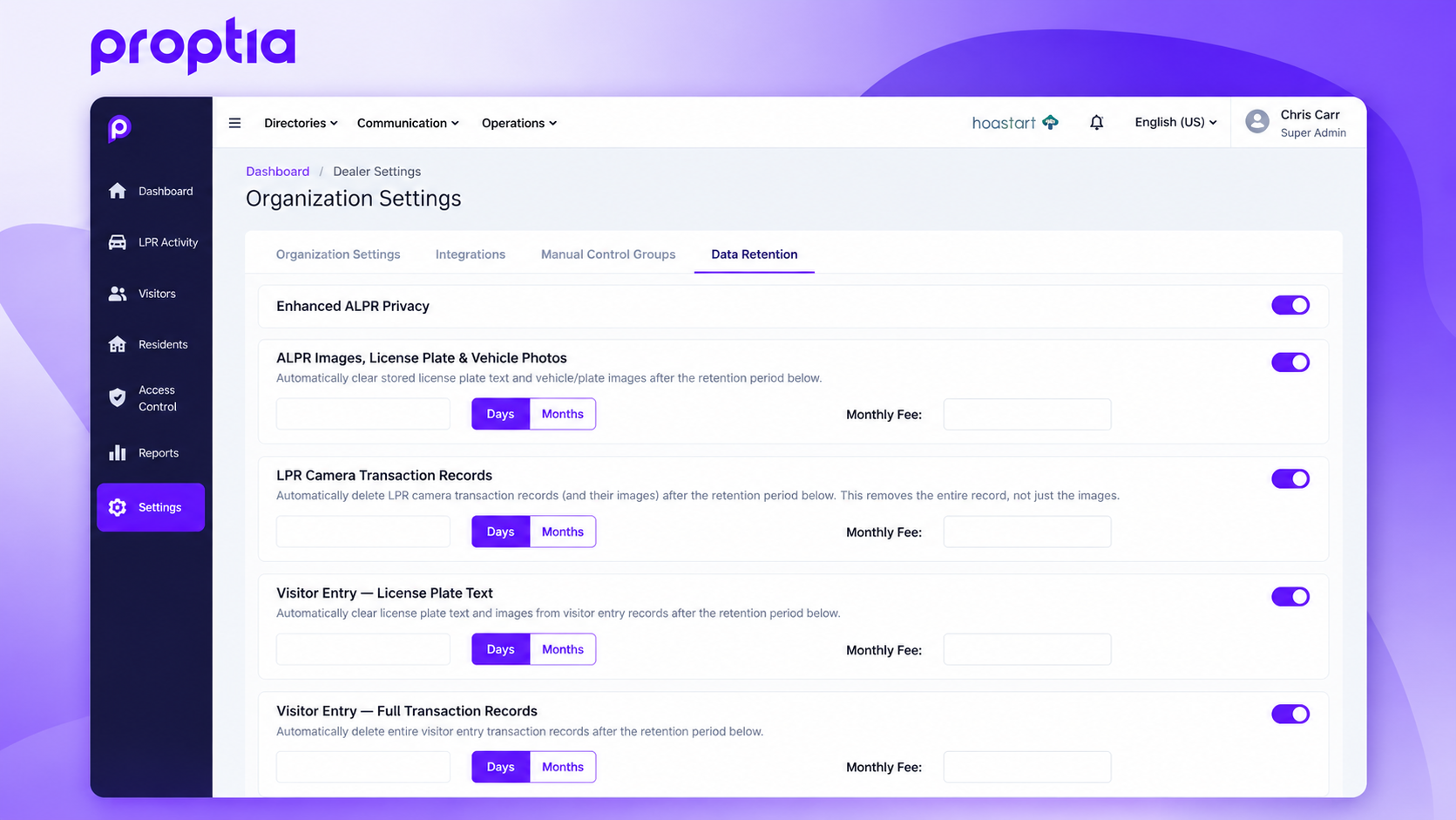
Private, Community-Controlled Vehicle Data
Proptia emphasizes an LPR model centered on the community’s own access and security environment.
The community can establish how vehicle information is used, accessed, retained, and shared according to its operational requirements and policies.
The goal is to provide useful vehicle intelligence without making participation in a broader vehicle surveillance network central to the deployment.
Proptia processes more than 18 million visitors and 73 million access control transactions annually across the communities it serves.
For gated communities evaluating LPR as part of a larger access control strategy, Proptia provides an alternative worth considering.
Flock Safety vs. Proptia: Which Is Better for HOAs?
Flock Safety and Proptia both use license plate recognition, but their platforms emphasize different operational requirements.
| Feature | Flock Safety | Proptia |
|---|---|---|
| Primary focus | Vehicle intelligence and investigations | Integrated community access and security |
| LPR cameras | Yes | Yes |
| Vehicle characteristic identification | Yes | Yes |
| Searchable vehicle activity | Yes | Yes |
| Vehicle alerts | Yes | Yes |
| Connected law enforcement collaboration | Yes | No |
| Resident plate-based gate access | Verify specific integration | Yes |
| Visitor plate-based authorization | Verify specific integration | Yes |
| Integrated visitor management | Depends on integration | Yes |
| Integrated access control | No | Yes |
| Entry and exit reporting | Vehicle activity records | Integrated vehicle and access transactions |
| Guardhouse operations | No | Yes |
| Private community data governance | Customer-controlled | Community-controlled |
| Typical use case | Investigative vehicle monitoring | Gated-community access and security operations |
When Flock Safety May Be a Better Fit
Flock may be particularly relevant for communities that:
- Primarily need investigative vehicle monitoring
- Do not have controlled vehicle entrances
- Want searchable vehicle activity across multiple locations
- Value optional collaboration with law enforcement
- Need solar-powered, cellular-connected camera deployments
When Proptia May Be a Better Fit
Proptia may be particularly relevant for communities that:
- Operate staffed, unattended, or hybrid gated entrances
- Want license plates to function as access credentials
- Need resident and visitor authorization
- Want integrated entry and exit reporting
- Use multiple access credential technologies
- Need visitor management and guardhouse operations
- Prefer an LPR deployment centered on private community security workflows
The best choice depends on the community’s objectives, existing infrastructure, privacy requirements, and desired workflows.
HOA boards should evaluate both platforms against real operating scenarios rather than relying exclusively on camera specifications or feature lists.
What Should HOA Boards Ask Before Choosing Flock Safety or an Alternative?
Before purchasing any license plate recognition system, boards should request clear answers to the following questions.
| Evaluation Area | Questions to Ask |
|---|---|
| Pricing | What is the annual cost per camera, including installation and ongoing service? |
| Total ownership cost | What will the complete system cost over five years? |
| Data ownership | Who contractually owns the license plate records? |
| Data hosting | Where is the information stored and processed? |
| Retention | What is the default retention period, and can it be changed? |
| External sharing | Can law enforcement or other organizations access community records? |
| Access controls | Who can search, export, or delete vehicle information? |
| Auditing | Can the HOA review searches and disclosures? |
| Gate integration | Can authorized plates automatically open existing gates? |
| Visitor management | Can residents authorize visitors using their license plates? |
| Entry and exit monitoring | Can the system track vehicle arrival and departure? |
| Reporting | Can management identify unregistered vehicles and time-on-site activity? |
| Connectivity | What happens during cellular or network outages? |
| Contract terms | What are the renewal, cancellation, and offboarding requirements? |
| Support | Who maintains the cameras, software, and integrations? |
A successful LPR deployment should reflect the community’s actual operating requirements.
For some neighborhoods, investigative vehicle intelligence may be the priority.
For others, the greater value comes from integrating vehicle recognition with everyday access control and security operations.
Entity Snapshot
- Flock Safety: Public safety technology provider offering license plate recognition, vehicle intelligence, and investigative tools.
- Proptia: Security operations platform integrating LPR, visitor management, access control, and gated-community operations.
- LPR: License Plate Recognition, technology that identifies vehicle license plates and creates searchable records.
- ALPR: Automated License Plate Recognition, another term for LPR.
- Connected LPR network: A system that can support authorized vehicle intelligence sharing across participating organizations.
- Private community-controlled LPR: License plate recognition configured around a property’s access, security, and data governance requirements.
- Access control: Technology that determines whether a person or vehicle is authorized to enter a controlled area.
- Visitor management: Software used to register, authorize, and track guests and service providers.
- Data retention: The period during which recorded vehicle information is stored before deletion.
- LPR as a credential: Using an authorized vehicle’s license plate to verify permissions and trigger gate access.
Frequently Asked Questions
What is Flock Safety?
Flock Safety is a public safety technology company that provides license plate recognition cameras, vehicle intelligence software, and investigative tools used by law enforcement, businesses, HOAs, and residential communities.
How does Flock Safety work?
Flock Safety uses license plate recognition cameras to capture license plates and vehicle characteristics. The information is sent to its cloud platform, where authorized users can search vehicle activity, review records, and receive alerts for designated vehicles.
How much does Flock Safety cost per camera?
Flock Safety’s standard fixed Falcon LPR cameras cost approximately $3,000 per camera annually, based on publicly available procurement contracts. Installation, additional services, and contract-specific requirements may increase the total cost.
How much does Flock Safety cost for an HOA?
At approximately $3,000 per camera annually, a four-camera Flock Safety deployment would cost roughly $12,000 per year or $60,000 over five years, excluding installation, additional services, and price changes.
What are the benefits of using Flock Safety?
Flock Safety provides searchable vehicle intelligence that can help communities investigate incidents, identify vehicles of interest, receive authorized vehicle alerts, and provide useful evidence to law enforcement.
Does Flock Safety share license plate data with police?
Flock supports optional law enforcement collaboration. The company states that customers own their data and control authorized sharing, with external sharing disabled by default.
Who owns Flock Safety license plate data?
Flock Safety states that customers retain ownership of the data collected by their cameras. Communities should still review their contracts and settings to understand access permissions, retention, sharing, auditing, and deletion.
How long does Flock Safety keep license plate data?
Flock Safety’s current standard LPR retention period is seven days. Actual retention can vary based on customer agreements, system configuration, applicable laws, and authorized retention settings.
What are the privacy concerns with Flock Safety?
Privacy considerations include who can search vehicle records, how long data is retained, whether information can be shared outside the community, and how access is audited. HOA boards should establish clear policies for each before deployment.
What is the difference between Flock Safety and private LPR?
Flock emphasizes vehicle intelligence, investigative searches, and optional connected-network collaboration. Private community-controlled LPR typically emphasizes property-specific vehicle monitoring, access permissions, visitor authorization, and community security operations.
Can Flock Safety open HOA gates automatically?
Flock offers LPR and third-party integrations, but HOA boards should verify whether their specific deployment supports automatic gate access and the resident and visitor authorization workflows required by their community.
Can Flock Safety help deter crime?
Flock Safety can support a broader security strategy by documenting vehicle activity and helping investigate incidents. LPR alone cannot guarantee crime prevention, and vehicle records should be treated as investigative information rather than proof that a driver committed a crime.
Is Flock Safety suitable for every community?
No single LPR platform is ideal for every community. Flock may fit neighborhoods prioritizing investigative vehicle intelligence, while gated communities may place greater value on integrated access control, visitor management, entry and exit tracking, and private community security workflows.
What are the best Flock Safety alternatives for gated communities?
Flock Safety alternatives include LPR platforms designed around private-property security and access control. Gated communities should compare vehicle recognition, gate integration, visitor management, data governance, reporting, integrations, and total cost rather than comparing cameras alone.
Is Proptia an alternative to Flock Safety?
Yes. Proptia provides license plate recognition integrated with visitor management, resident vehicle access, gate control, guardhouse operations, entry and exit reporting, and broader gated-community security operations.
Get in Touch to Learn More About Proptia License Plate Recognition
License plate recognition can do much more than capture vehicle information.
When integrated with visitor management, access control, and security reporting, LPR becomes a practical tool for managing resident access, streamlining visitor entry, and improving visibility into community vehicle activity.
Proptia helps HOAs and gated communities connect these workflows through one security operations platform.
See how Proptia LPR works with your existing gate infrastructure, visitor management, and community access requirements.
Schedule a Demo of Proptia Today!
Get in Touch to Learn More About Proptia License Plate Recognition
License plate recognition can do much more than capture vehicle information.
When integrated with visitor management, access control, and security reporting, LPR becomes a practical tool for managing resident access, streamlining visitor entry, and improving visibility into community vehicle activity.
Proptia helps HOAs and gated communities connect these workflows through one security operations platform.